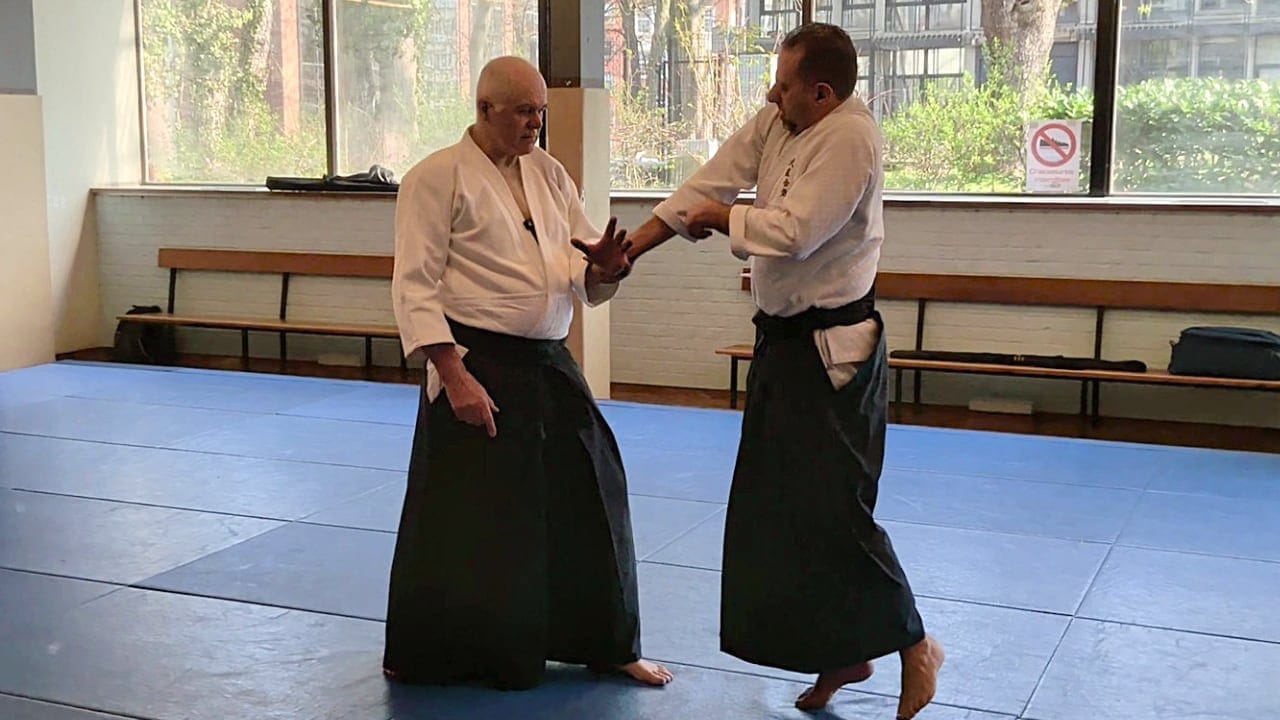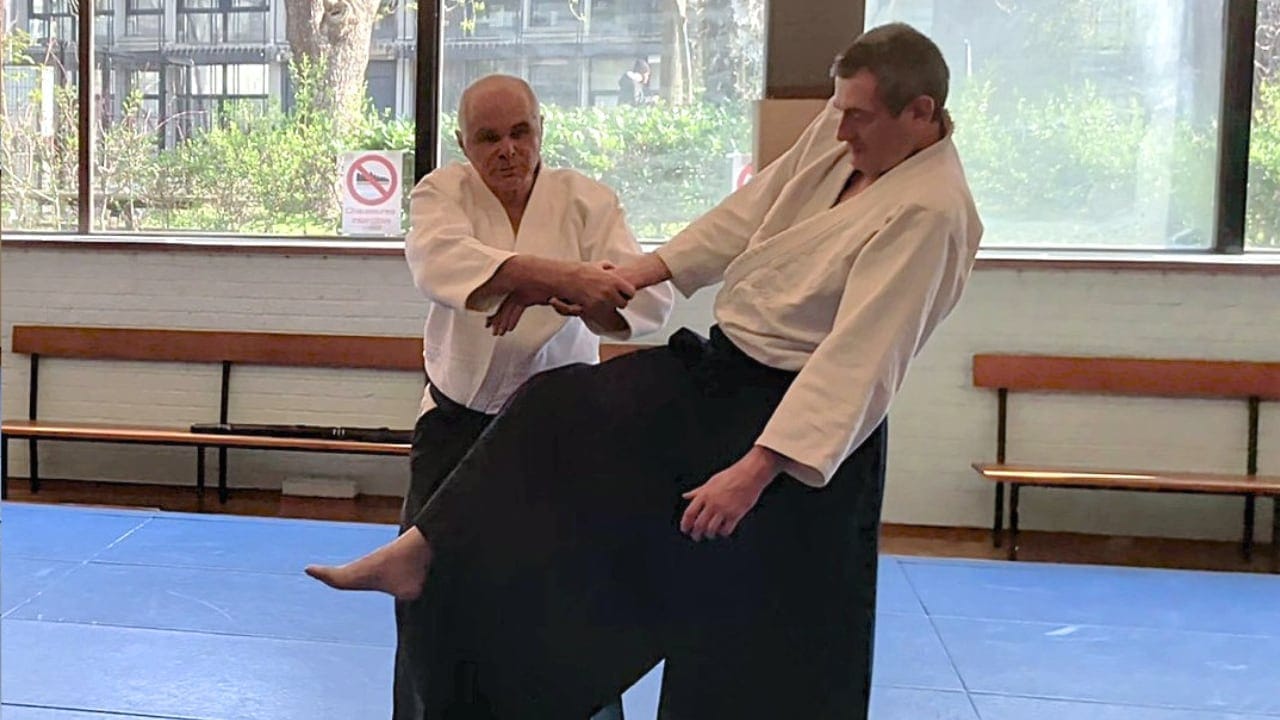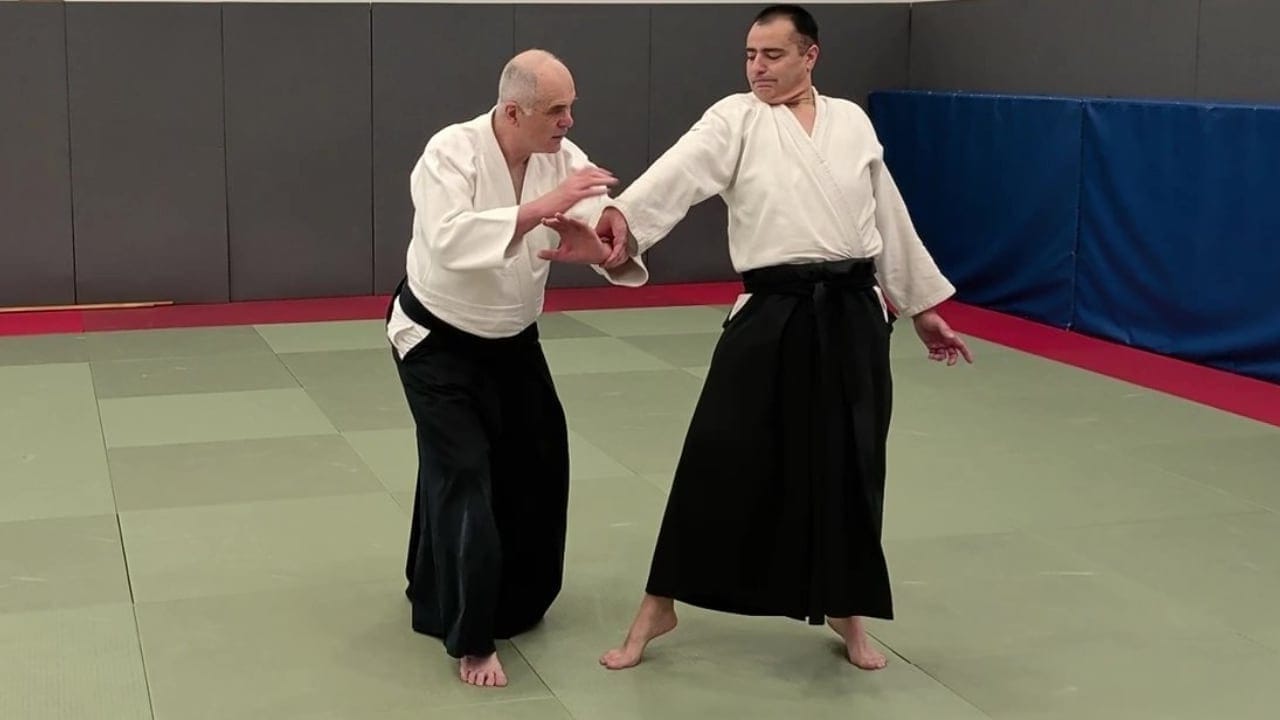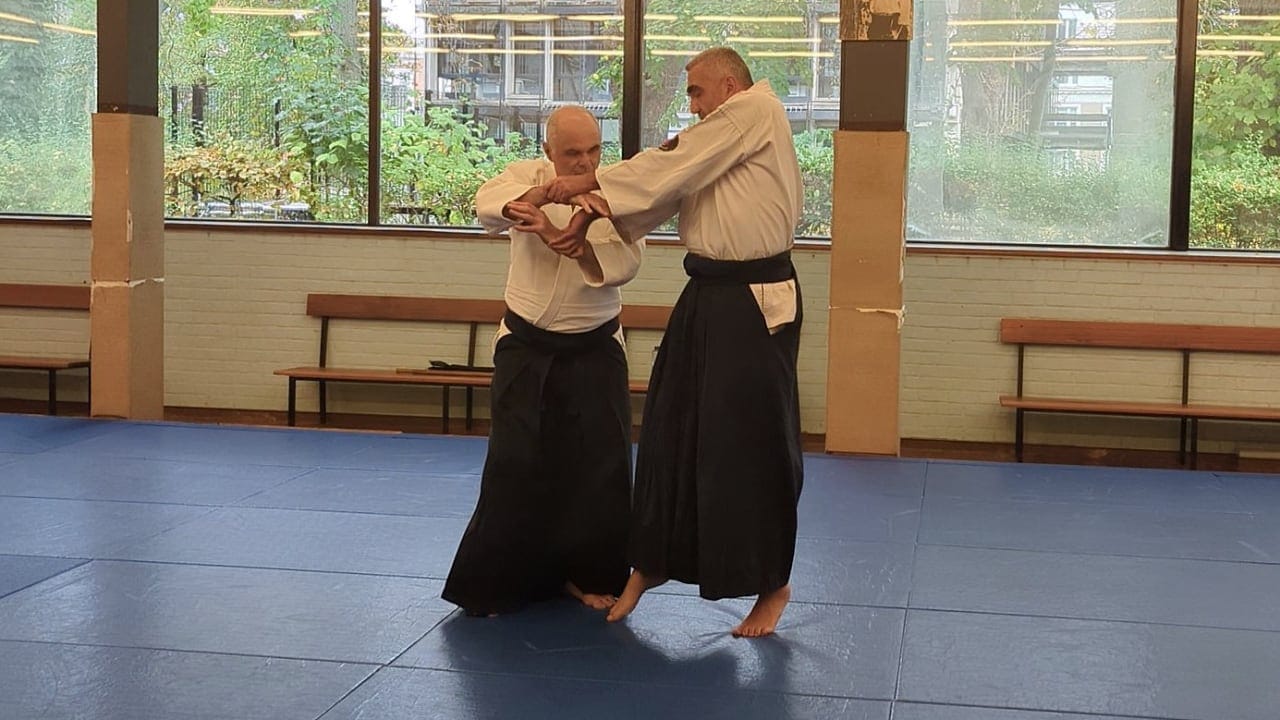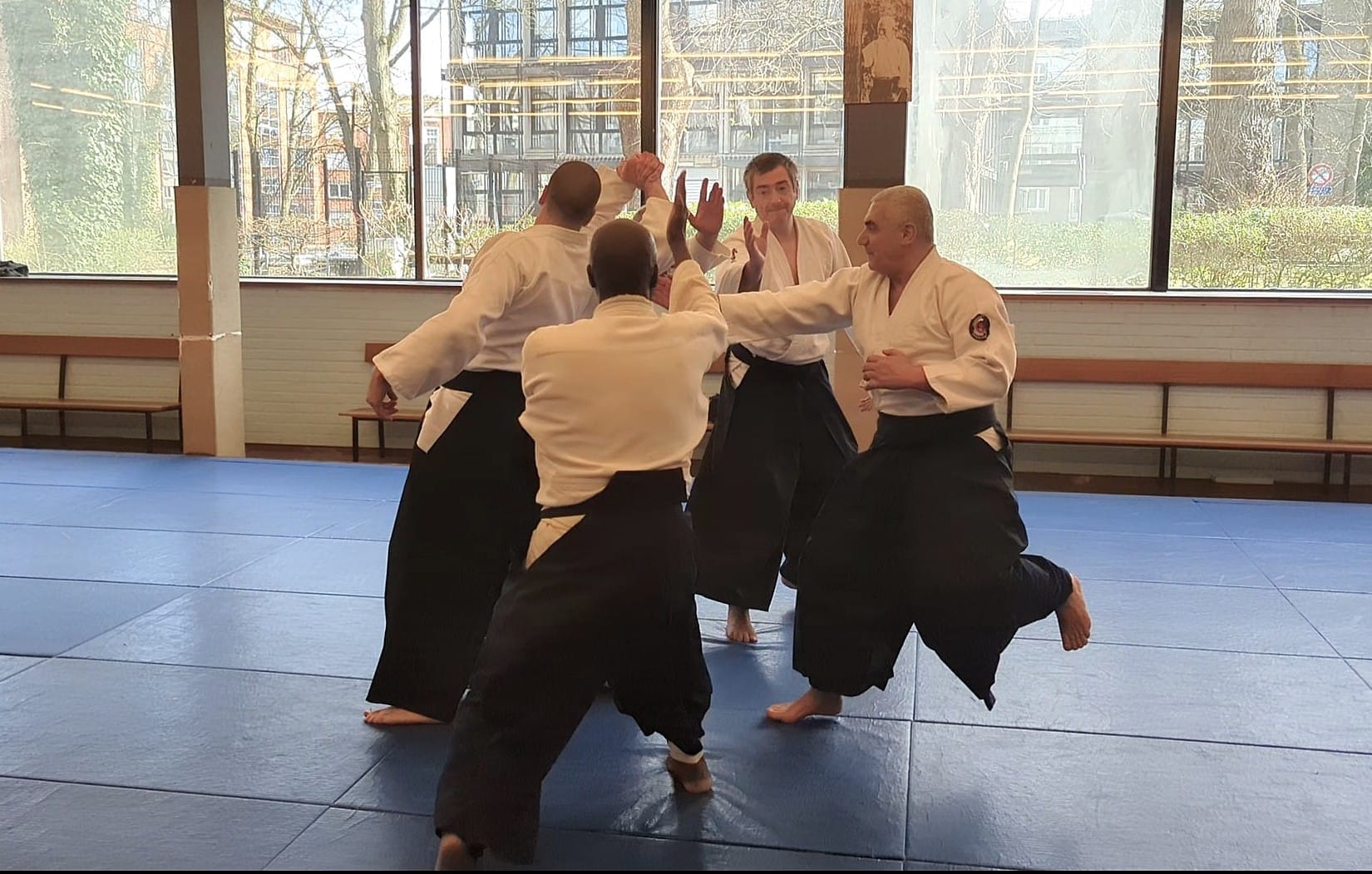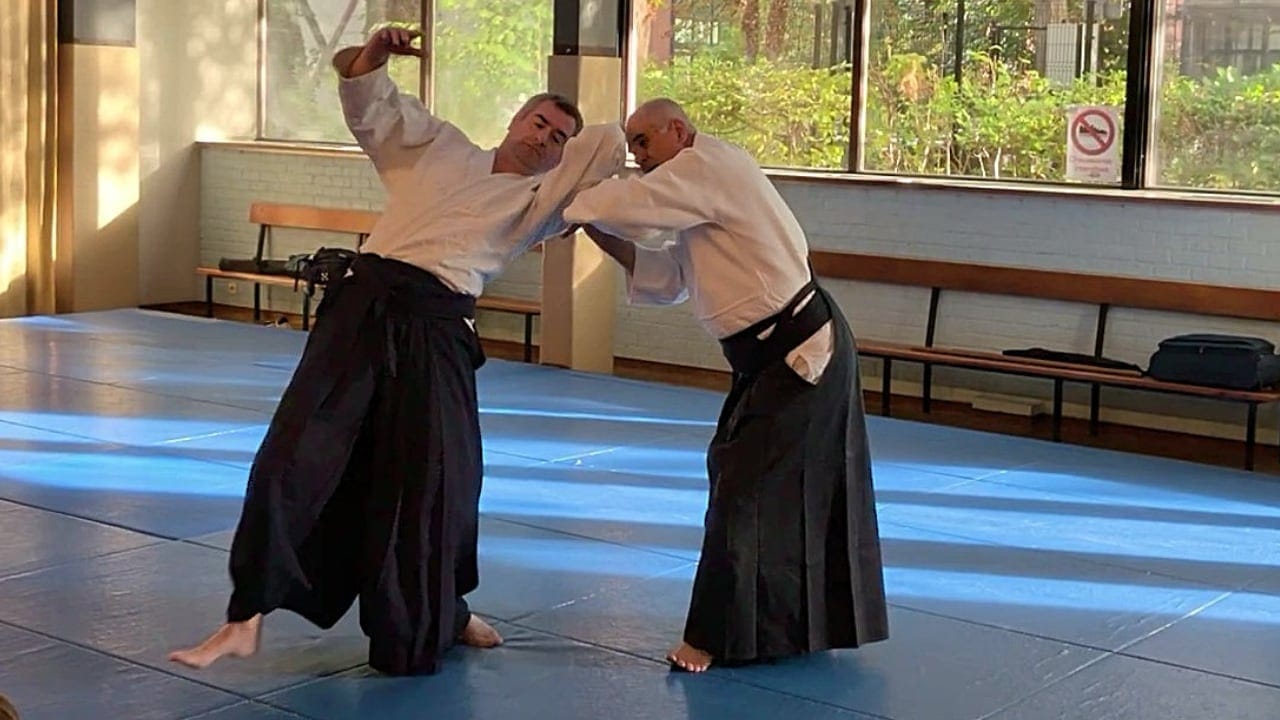
The thrust of tori’s grasped hand towards uke’s shoulder, through uke’s outstretched arm, and the subsequent rotation of that arm, send uke towards tori’s back, thereby forcing uke to move in a 90° arc.
At the same time, the rotation of tori’s body through a 270° arc in the opposite direction to uke’s movement is such that, at the point where the two forces meet, the full 360° of the circle has been completed.
Uke’s loss of balance and the resulting technique are the outcome of this dual, opposing movement. Izanagi and Izanami rotate in opposite directions around the axis of the world (the Floating Bridge), and each time they meet, they create: Aikido is the concrete manifestation of laws whose image is found in Japanese cosmogony.
The video demonstrates this:
A simple 180° pivot is too short; it is not sufficient to wrap uke’s arm behind their back, and therefore to unbalance them perfectly – especially if uke has not been sent correctly backwards by tori’s initial action.
The shomen uchi strike, which is generally taught following such a 180° pivot, then throws uke forwards with his arm extended. In this situation, he is able to execute a counter-technique. If he cannot do so, he is in any case free to fall forwards, and may then, whilst falling, strike tori, who is within range of his free fist.
The 270° turn is absolutely essential for the correct execution of shiho nage. It is therefore necessary to know the method that allows one to turn 270° without lifting one’s feet off the ground. This method exists; it is the method used by O Sensei Morihei Ueshiba, and it is the foundation of Aikido, but knowledge of it was lost after his death. I propose that we rediscover it.